
How Long Do DOT Violations Stay on Your Record?
· Michael R. Holt
There is no single answer: CSA scores drop violations at 24 months, MVRs vary by state, the Drug and Alcohol Clearinghouse holds records for 5 years, and litigation discovery has no expiry at all.
How Long Do DOT Violations Stay on Your Record?
Ask this question in a truck stop and you will get a confident answer: two years. Ask a safety director and you will get three. Ask a lawyer and you will get a question back — which record?
The confident answers are all partially right, which is what makes this so confusing. A single roadside violation gets recorded in several independent systems, each with its own retention rule, and they do not expire together. A violation can be invisible in one place, still counting against you in another, and permanently available in a third.
Here is each clock, what it governs, and when it actually stops.
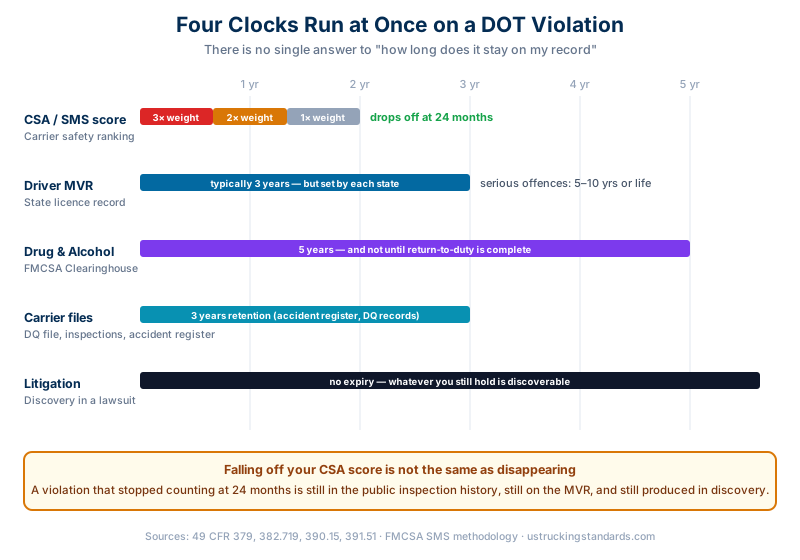
Clock 1: Your CSA Score — 24 Months, Weighted
This is the one people mean when they say “two years,” and it is the only clock where a violation’s effect fades gradually rather than ending abruptly.
In the Safety Measurement System, every violation is weighted by how recent it is:
| Age of violation | Weight applied |
|---|---|
| 0 to 6 months | 3× |
| 6 to 12 months | 2× |
| 12 to 24 months | 1× |
| Over 24 months | Removed from the calculation |
So a violation does not sit at full strength for two years and then vanish. It loses two-thirds of its weight after six months and another third after a year. The practical consequence is encouraging: a carrier with a bad quarter recovers faster than it fears, provided it stops generating new violations while the old ones age down.
The full mechanics — severity weights, peer grouping, and the intervention thresholds these scores feed — are in our guide to CSA scores and the seven BASICs.
Important limitation: the 24-month rule governs the score, not the record. The inspection itself stays in FMCSA’s public inspection history indefinitely. Anyone who looks up your DOT number can see a violation from four years ago; it simply no longer contributes to your percentile.
Clock 2: The Driver’s MVR — Usually 3 Years, Set by the State
The Motor Vehicle Record belongs to the state that issued the licence, and the federal government does not set its retention period. This is where the “three years” answer comes from, because three years is the most common state practice and also the lookback period a carrier must obtain when hiring.
But the variation between states is real and significant:
- Most moving violations: around 3 years, though some states keep them 5.
- Serious traffic violations (excessive speeding, reckless driving, improper lane changes resulting in a fatality): longer, and they carry federal disqualification consequences under 49 CFR 383.51 regardless of how long the state keeps them.
- Major offences (DUI in a commercial vehicle, leaving the scene, using a CMV to commit a felony): a first conviction carries a one-year disqualification, a second carries lifetime disqualification. The conviction itself may remain on the record permanently.
- Hazmat-related offences: longer retention in several states because of the security implications.
For a driver, the practical question is not when the violation leaves the MVR but what a prospective employer sees in the three-year lookback they are required to run. A violation that technically ages off at year three but falls inside the window of a hiring review has already done its work.
Clock 3: The Drug and Alcohol Clearinghouse — 5 Years, Conditionally
This is the longest of the regular clocks and the one that catches drivers by surprise.
Under 49 CFR 382.719, a drug or alcohol programme violation stays in the FMCSA Clearinghouse for five years from the date of the violation, or until the return-to-duty process is complete — whichever is later.
That second condition matters more than the first. The five-year countdown does not quietly run in the background while a driver gets on with life. If the driver has not completed the return-to-duty process — evaluation by a Substance Abuse Professional, prescribed education or treatment, a negative return-to-duty test, and the follow-up testing plan — the record stays indefinitely. A driver who tested positive, left the industry, and came back eight years later still has an open record.
Every employer is required to query the Clearinghouse before hiring and annually for current drivers, so there is no version of this that goes unnoticed. The query and return-to-duty mechanics are in the FMCSA Clearinghouse explained.
Clock 4: Your Own Files — 3 Years, Then Your Choice
Federal recordkeeping rules tell carriers how long they must keep records, not how long they may:
| Record | Minimum retention |
|---|---|
| Accident register | 3 years (49 CFR 390.15) |
| Driver qualification file | Duration of employment + 3 years |
| Roadside inspection reports | 12 months |
| Hours of service records | 6 months |
| Drug and alcohol test records | 1 to 5 years depending on result |
Once the minimum passes, retention becomes a judgement call, and it is a more consequential one than it looks. Records you still hold are records that can be produced in discovery. Records you destroyed on a documented, consistently applied schedule are gone legitimately. Records you destroyed after litigation became foreseeable are spoliation — the subject our first 24 hours after an accident guide covers in detail.
The defensible position is a written retention schedule that you follow uniformly, with a litigation hold procedure that overrides it the moment a claim becomes likely. Ad-hoc deletion is the dangerous middle ground.
The Clock With No Expiry: Litigation
In a lawsuit, retention schedules are irrelevant to the question of what gets examined. Whatever you still possess is discoverable, and plaintiff counsel will request years of history regardless of whether any of it still affects your CSA score.
A violation from four years ago that dropped off your SMS percentile long ago can still be presented to a jury as part of a pattern. The argument is not that the violation caused this crash — it is that the carrier had a documented history and did not act on it. Our breakdown of how a nuclear verdict case gets built covers how that history is assembled from exactly these records.
This is the clock that makes the others less comforting than they appear.
Getting a Violation Removed Early
The clocks assume the violation is valid. Not all of them are.
DataQs is the channel for challenging violation records, and it works for genuine errors: wrong DOT number, wrong driver, duplicate entries, a citation written under a regulation that does not apply to your operation. What it will not do is remove a correct violation because you think it was harsh.
Two points of timing:
- File immediately. With 3× weighting in the first six months, removing a violation at month two eliminates far more score than removing the same violation at month twenty.
- Dismissed citations can help. If a court dismissed the underlying citation, submit the disposition through DataQs. Depending on the state and the violation, the record may be removed or annotated. A conviction reduced to a non-moving offence is also worth submitting.
For crashes specifically, the Crash Preventability Determination Program lets carriers request review of certain crash types — being struck in the rear, struck by a wrong-way driver, struck while legally stopped, animal strikes. A successful determination removes the crash from your Crash Indicator calculation. Many carriers never file and carry crashes someone else caused for the full two years.
The Short Version
| Question | Answer |
|---|---|
| How long does it affect my CSA score? | 24 months, with weight falling at 6 and 12 months |
| How long is it on the public inspection record? | Indefinitely |
| How long on the driver’s MVR? | Usually 3 years, longer for serious offences, lifetime for some |
| How long in the Clearinghouse? | 5 years, or until return-to-duty is complete — whichever is later |
| How long must I keep my own records? | 3 years for most, then your documented schedule |
| How long can it be used against me in court? | As long as the record exists |
The unifying point: ageing off your CSA score is not the same as disappearing. The first is automatic and the second does not happen. Plan on the assumption that a violation is permanent in some system, and the shorter clocks become a pleasant surprise rather than a strategy.
This article explains federal retention rules in general terms for educational purposes. State MVR rules vary materially and change — verify with your state licensing agency, and consult counsel on retention policy for your operation.