
The FMCSA Clearinghouse Explained: Queries, Violations and Return-to-Duty
· Michael R. Holt
Full queries versus limited queries, the consent rules that catch carriers out, the three-day reporting deadline, what prohibited status means since the 2024 CDL downgrade rule, and how return-to-duty actually works.
The FMCSA Clearinghouse Explained: Queries, Violations and Return-to-Duty
The Drug and Alcohol Clearinghouse is the most procedurally unforgiving system a motor carrier deals with. Not because the rules are complicated — they are not — but because the failures are binary and countable. You either ran the query or you did not. You either ran the right type or the wrong one. An investigator comparing your driver roster against the query log finds gaps in minutes, and each gap is its own violation.
It also sits upstream of everything else. A Clearinghouse failure shows up in your CSA Controlled Substances BASIC, in a compliance review’s Driver factor, and in discovery if the driver is ever in a serious crash.
Here is how the system actually works.
Two Query Types, Two Consent Rules
This is where most carriers go wrong, because the difference sounds administrative and is not.
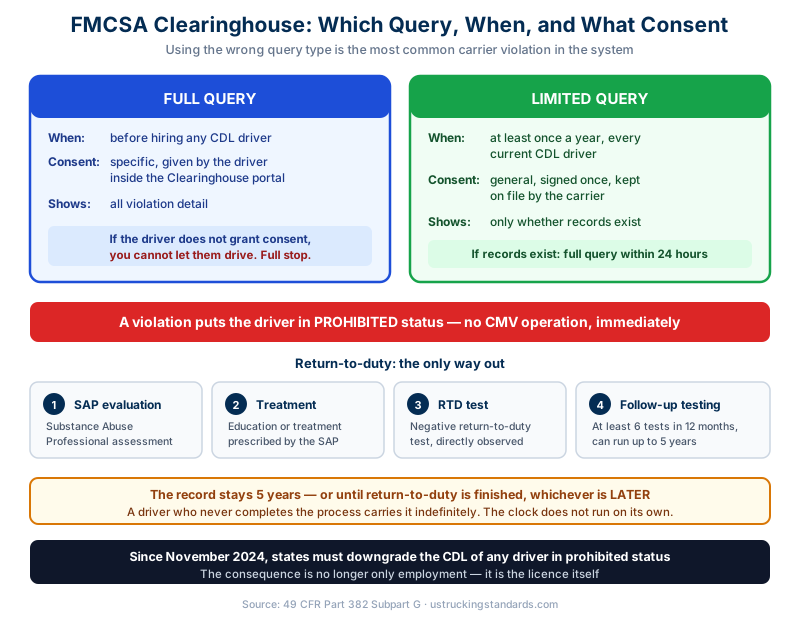
The full query is required before you let any CDL driver operate a commercial vehicle for you. It returns complete detail of any violation in the driver’s record. Critically, it requires specific electronic consent given by the driver inside the Clearinghouse portal — not a form they signed, not an authorisation in the application packet. The driver logs in and grants it for that query.
If the driver does not grant consent, you cannot query. And if you cannot query, you cannot let them drive. There is no workaround, no provisional period, no “we’ll sort it out next week.” A carrier that puts a driver to work while waiting for consent is operating in violation from the first mile.
The limited query is the annual check you must run on every current CDL driver at least once every twelve months. It uses general consent — a written authorisation the driver signs once, which you keep on file and which can cover multiple years. It returns only whether records exist, not what they are.
If a limited query comes back showing records exist, you have 24 hours to run a full query. Until you do, the driver must stop operating.
The two mistakes investigators find most often: running a limited query pre-employment when a full query was required, and keeping general consent on file while believing it covers full queries. It does not.
Who Has to Register
Every employer of CDL drivers, which includes operations that do not think of themselves as employers.
Owner-operators are the recurring blind spot. An owner-operator with their own authority is simultaneously the employer and the driver, and federal rules do not let you query yourself. You must designate a consortium/third-party administrator (C/TPA) to run your queries and report on your behalf. Owner-operators who assume the requirement does not apply to a one-person company are non-compliant from day one, and this surfaces immediately during a New Entrant Safety Audit.
Employers must also register to report violations, not only to query. Those are separate functions in the portal.
What Gets Reported, and How Fast
Employers must report to the Clearinghouse within three business days:
- An alcohol confirmation test of 0.04 or higher
- A refusal to test — which includes failing to appear, leaving before the test, refusing to provide a specimen, and a verified adulterated or substituted sample
- Actual knowledge of prohibited conduct — you saw it, or it was admitted, or a citation was issued
- A negative return-to-duty test result
- Completion of the follow-up testing plan
Medical Review Officers report verified positive drug tests directly; the employer does not duplicate that. Substance Abuse Professionals report the start of the return-to-duty process.
Three business days is short. By the time the paperwork arrives on a safety manager’s desk, part of the window has often gone. Carriers that handle this well assign the reporting duty explicitly to a named person with a backup, rather than leaving it to whoever opens the envelope.
Prohibited Status, and What Changed in 2024
Any reported violation places the driver in prohibited status. That means no operation of any commercial motor vehicle requiring a CDL, for any employer, anywhere in the country, effective immediately. Every carrier that queries them sees it.
Until recently, the consequence was employment-related: a prohibited driver could not legally be dispatched, but the licence itself was untouched. Since November 2024 that is no longer true. Under the second phase of the Clearinghouse rule, state licensing agencies query the Clearinghouse and must downgrade the commercial privilege of any driver in prohibited status — removing the CDL or CLP privilege from the licence until the driver completes return-to-duty.
This changes the calculation for drivers who previously waited things out, and it changes what carriers find at hiring. A driver can now turn up with a downgraded licence whose cause is not visible on the MVR but is sitting plainly in the Clearinghouse.
Return-to-Duty: The Only Way Out
The process has four stages and no shortcuts:
- SAP evaluation. The driver selects a qualified Substance Abuse Professional at their own cost and completes an assessment. The carrier must provide a list of SAPs but is not obliged to pay.
- Education or treatment as prescribed by that SAP, followed by a re-evaluation confirming compliance.
- Return-to-duty test — a directly observed test that must be negative. This can only be arranged by an employer, which creates the catch drivers run into: a prohibited driver needs an employer willing to take them on to get tested.
- Follow-up testing plan — at least six unannounced tests in the first twelve months, and the SAP can extend the regime for up to five years.
The driver returns to non-prohibited status after the negative return-to-duty test, but the record and the follow-up obligations continue.
How Long the Record Lasts
Five years from the violation date, or until return-to-duty is complete, whichever is later.
That second condition is the one people miss. The five-year countdown does not run quietly in the background while a driver does something else. A driver who tested positive, left trucking, and returned eight years later still has an open record and is still prohibited, because the process was never finished. We cover how this interacts with the other retention clocks in how long DOT violations stay on your record.
Building a Programme That Passes Audit
An investigator will ask for your query log and compare it against your driver roster. Five things make that comparison come out clean:
- A named owner for Clearinghouse duties, with a documented backup. Reporting deadlines are measured in business days; absence is not an excuse.
- A query calendar, not a memory. Annual limited queries are easy to let slip by two or three months, and every month late is a violation per driver.
- General consents on file for every current driver, reviewed when drivers join and leave.
- Full query completed and recorded before the first dispatch, not before the first payroll run. The line is operation of the vehicle.
- Three-day reporting treated as a standing procedure, with the forms and portal access ready before you need them for the first time.
The underlying principle is that this is one of the few compliance areas with no judgement calls and no room for interpretation. That makes it unforgiving when neglected and genuinely straightforward when systematised — which is also why investigators start here.
This article explains federal requirements in general terms for educational purposes, not legal advice. Clearinghouse rules have been amended several times since launch — verify current requirements at the FMCSA Clearinghouse site before setting procedure.