The First 24 Hours After a Truck Accident: A Carrier's Response Playbook
· Michael R. Holt
Hour by hour: what a motor carrier must do after a serious accident — scene protocol, federal drug and alcohol testing deadlines, evidence preservation, and the three decisions that cannot be undone.
The First 24 Hours After a Truck Accident: A Carrier’s Response Playbook
The call comes at 2:40 a.m. A tractor-trailer has been involved in a collision on an interstate three states away. There are injuries. The driver is shaken but unhurt.
What happens in the next twenty-four hours will shape the next two years. Not because the facts of the crash change — they are already fixed — but because three things are decided in that window that no amount of later work can reverse: what was said, what was preserved, and whether the carrier’s own investigation can be used against it.
This is the operational version of the problem. For the adversarial view of why these hours matter so much, see our breakdown of how plaintiff attorneys build a nuclear verdict case — their clock starts at the same moment yours does.
Minutes 0–30: The Scene
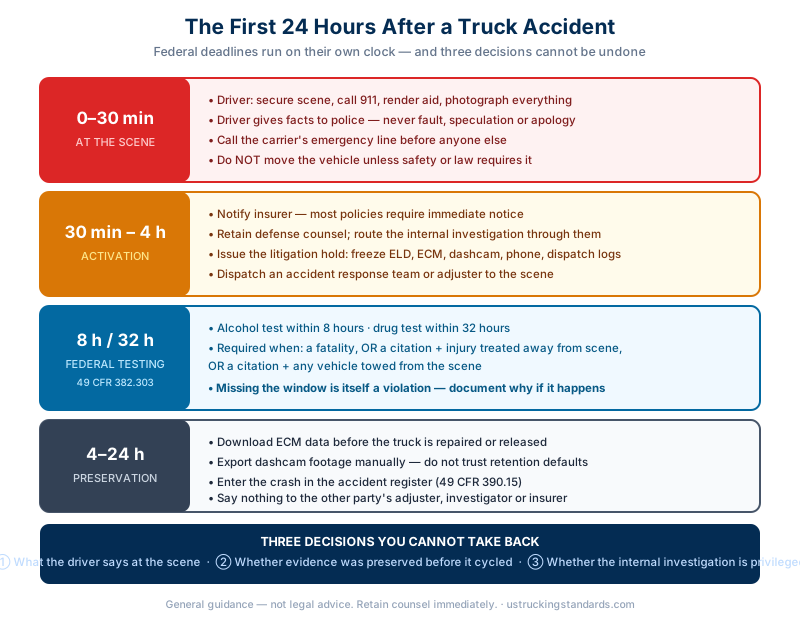
The driver’s obligations are simple and should be trained to the point of reflex: secure the scene, call 911, render aid within the limits of their training, and photograph everything — all vehicles from multiple angles, skid marks, road conditions, weather, traffic controls, debris field, and the other vehicle’s occupants if they are visible and ambulatory.
Then the part that is harder to train: what the driver says.
Police will ask what happened. The driver answers factually — direction of travel, speed, lane position, what they observed. What the driver does not do is characterize fault, speculate about cause, or apologize. “I’m so sorry, I didn’t see them” is a human reflex at the scene of an injury crash and it will be read into the record eighteen months later as an admission. The distinction to train is between reporting and concluding: the driver reports; investigators conclude.
The driver should also call the carrier’s emergency line before calling anyone else — before family, before a dispatcher who happens to be a friend. Those early calls generate statements too, and dispatch recordings are discoverable.
Do not move the vehicle unless law enforcement directs it or safety requires it. Final rest positions are evidence, and a truck moved for convenience destroys the reconstruction that may exonerate you.
Minutes 30 to Hour 4: Activation
This is where the carrier’s side begins, and four things run in parallel.
Notify the insurer. Nearly every commercial auto policy requires prompt notice, and late notice can become a coverage dispute on top of a liability case. Make the call even when the carrier believes it was not at fault.
Retain defense counsel — and route the investigation through them. This is the decision carriers most often get wrong, because it feels premature. It is not.
An internal investigation conducted by the safety department produces documents the carrier owns: incident reports, root-cause analyses, internal emails assessing what went wrong. All of it is discoverable. A safety manager’s honest memo saying “we should have pulled this driver off the Atlanta lane after the last two events” is, in the plaintiff’s hands, the case.
The same investigation conducted at the direction of counsel, in anticipation of litigation, may be protected by attorney-client privilege and the work-product doctrine. The protection is not automatic and it is not absolute — courts examine whether counsel genuinely directed the work and whether the documents would have been created anyway in the ordinary course of business — but it is unavailable entirely if counsel was never engaged. The structural choice is made in the first hours, and it cannot be applied retroactively to documents already written.
Issue the litigation hold. The duty to preserve evidence attaches when litigation is reasonably anticipated, which a serious injury crash satisfies on its own — the opposing party’s preservation letter is confirmation, not the trigger. The hold must reach every system with a retention clock: ELD provider, dashcam platform, ECM data, dispatch and messaging logs, driver phone records, maintenance records for the unit, and the DQ file.
This needs to be a written protocol executable by whoever answers the phone at 2:40 a.m. Our DOT compliance checklist covers the file structure; the hold procedure is the one-page addendum that tells a night dispatcher which five systems to freeze and who to call.
Get someone to the scene. For a serious crash, an accident response service or adjuster on site within hours captures conditions that change: light, weather, traffic patterns, the position of everything before it is cleared.
The Federal Testing Clock: 8 Hours and 32 Hours
Running independently of everything above is a deadline in 49 CFR 382.303 that carriers miss more often than any other post-accident obligation.
Post-accident drug and alcohol testing is required when the crash involves:
- A fatality — testing required regardless of citation; or
- A citation issued to the driver and bodily injury treated away from the scene; or
- A citation issued to the driver and any vehicle towed from the scene.
When triggered, the windows are:
| Test | Deadline | If missed |
|---|---|---|
| Alcohol | 8 hours | Stop attempting after 8 h; document every attempt and the reason for failure |
| Controlled substances | 32 hours | Stop attempting after 32 h; document attempts and reason |
Two points carriers get wrong. First, the citation does not have to be issued at the scene — a citation issued days later can retroactively trigger the requirement, which is why the conservative practice is to test whenever there is injury or a tow and resolve the citation question afterward. Second, failing to test is itself a violation, and so is failing to document why testing did not occur. An investigator reviewing the file wants to see either results or a contemporaneous record of attempts: which collection sites were called, when, and why the test could not be completed. “The driver was in the hospital” is an acceptable explanation only if it is written down at the time.
A driver who refuses testing is treated as having tested positive, with all the consequences that follow under the Clearinghouse rules.
Hours 4–24: Preservation and Silence
Download the ECM data before the truck moves to a repair facility. Engine control module data — speed, brake application, throttle position, often in the final seconds before impact — is frequently the single most useful piece of evidence, and it is also the most easily lost. Some modules overwrite on subsequent key cycles. A repair shop that powers the unit up to assess damage can destroy it without knowing. The download is done by a qualified technician, documented with chain of custody, with notice to the other side where litigation is anticipated.
Export dashcam footage manually. Do not assume the cloud retention default protects you. Pull the clips for the full shift, not just the triggered event, and store them outside the normal rotation.
Enter the crash in the accident register. 49 CFR 390.15 requires a register of all DOT-recordable accidents, maintained for three years, with the date, location, driver, injuries, fatalities, and whether hazardous materials were released. It is one of the first things an FMCSA investigator asks for, and a register that is incomplete or reconstructed after the fact signals a carrier that does not track its own safety events.
Say nothing to the other side. The opposing party’s insurer or investigator may call within hours, often framed as routine information gathering. Every carrier employee should have one answer: “Our counsel will respond to that,” followed by the lawyer’s contact. Recorded statements given early, without preparation, by people who do not yet know what the evidence shows, are a recurring source of damage.
Days 2–7: The Transition
The acute phase ends and the long one begins. In the first week the carrier should have:
- A preliminary internal timeline assembled under counsel’s direction
- Confirmation in writing from every vendor that the hold is in place and data is preserved
- The driver interviewed — with counsel, not by the safety manager alone
- The DQ file, maintenance file, and HOS records for the relevant period assembled and reviewed before anyone else sees them
- A decision, with counsel, on whether to retain an accident reconstructionist
That last point matters more than it sounds. Reconstruction evidence degrades fast — the roadway is cleared, vehicles are repaired or scrapped, witness memories shift. A carrier that waits to see whether a lawsuit materializes before investigating has already lost the ability to build the version of events it may later need.
The Driver
One operational note that gets lost in the legal mechanics: the driver of a truck involved in a fatal crash is often traumatized, whether or not they were at fault. Carriers that put drivers straight back in the seat, or treat them as a liability to be managed, generate turnover and — in the uglier cases — a former employee who becomes a cooperative witness for the plaintiff.
Getting the driver home, arranging support, and keeping them informed is both the decent response and the one that protects the company. Discipline, where warranted, comes after the facts are established, not in the first forty-eight hours.
What This Rests On
Everything in this playbook assumes the underlying records already exist and are clean. The hold preserves what you have; it does not create a DQ file that was never completed or coaching records for events nobody addressed. A carrier that executes the first 24 hours perfectly but hands counsel a thin file is in the same position described in our nuclear verdict analysis — the response was excellent and the exposure was built years earlier.
The two halves of accident preparedness are a response protocol that works at 2:40 a.m. and a compliance file that can withstand being read by a hostile reader. Neither substitutes for the other.
This article is general operational guidance, not legal advice. Post-accident obligations vary by jurisdiction and circumstance — retain qualified defense counsel immediately after any serious accident.