
Anatomy of a Nuclear Verdict: How Plaintiff Attorneys Build a $30M Trucking Case
· Michael R. Holt
A phase-by-phase breakdown of how plaintiff attorneys build catastrophic trucking verdicts — the spoliation letter, public record mining, the standard discovery request, reptile depositions — and what each phase pulls from your files.
Anatomy of a Nuclear Verdict: How Plaintiff Attorneys Build a $30M Trucking Case
Most trucking safety content is written from the defensive crouch: protect your fleet, document everything, buy enough coverage. Useful advice, but it leaves out the part that would make it stick — what the other side is actually doing, in what order, and why.
A nuclear verdict is not a jury overreacting to a bad accident. It is a constructed argument, assembled over eighteen months from documents the carrier produced itself, following a playbook that has become standardized across the plaintiff’s bar. Understanding that playbook is more useful than any checklist, because it tells you which of your records are load-bearing and when they get examined.
Here is how the case gets built.
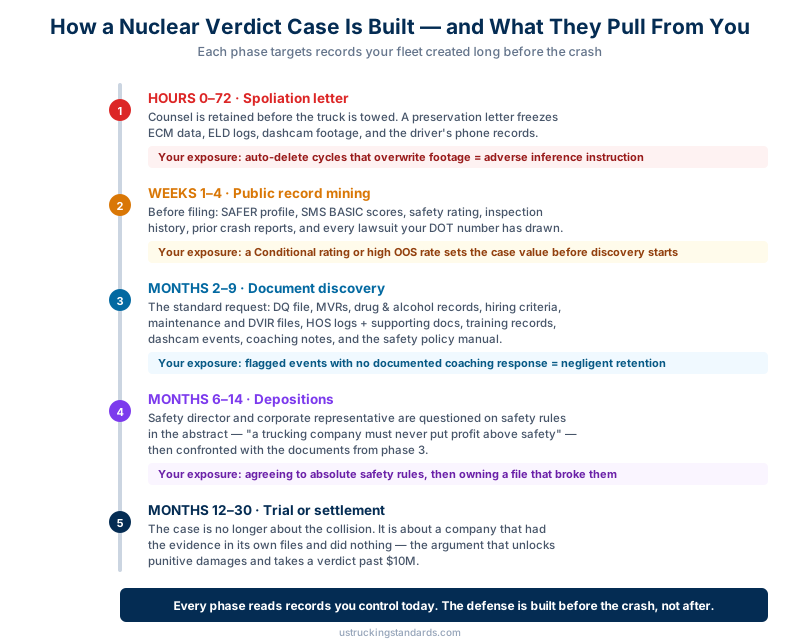
Phase 1: The First 72 Hours
The crash happens at 3 a.m. By the time the carrier’s safety director has finished the first call with the insurance adjuster, plaintiff’s counsel may already be retained — catastrophic injury firms monitor scanner traffic and maintain relationships with first responders, and the family of a severely injured victim is often contacted within a day.
The first document the carrier receives is not a lawsuit. It is a spoliation letter: a demand to preserve specific categories of evidence. A well-drafted one is remarkably specific — ECM/black box data, ELD records for the driver and the tractor, all dashcam footage inward and outward for a stated window, the driver’s cell phone records, dispatch communications, the trip’s bills of lading, and the truck itself in its post-crash condition.
That letter is doing two things at once. It preserves evidence, and it creates a trap. Once received — and, courts have held, once litigation is merely reasonably anticipated, which a fatality crash satisfies on its own — the duty to preserve attaches. Any routine process that destroys covered evidence afterward becomes spoliation.
The most common way carriers fail here is passive: a dashcam system on a 30-day auto-delete cycle, an ELD provider whose retention default is six months, a maintenance system that purges closed work orders. Nobody deletes anything deliberately. The clips simply age out while the carrier is focused on the injured driver and the insurance claim.
The consequence is disproportionate. A judge who finds spoliation can issue an adverse inference instruction: the jury is told it may assume the missing evidence would have been unfavorable to the carrier. Defense counsel will tell you the case is effectively over at that point. Carriers lose cases on spoliation that they would have won on the facts — the footage that was deleted often showed the truck driving correctly.
What this means today: your litigation hold procedure has to be executable by whoever is awake when the call comes in. A written one-page protocol — who to notify, which systems to freeze, how to export footage before the cycle turns — is the single highest-return document in your safety file.
Phase 2: Mining the Public Record
Before a complaint is filed, the plaintiff’s team builds a profile of the carrier entirely from public sources. This costs them almost nothing and determines how the case will be framed.
They pull:
- The SAFER profile — fleet size, cargo carried, operating authority history, insurance filings.
- SMS BASIC scores — Unsafe Driving, HOS Compliance, Vehicle Maintenance, Driver Fitness. Percentile ranks above intervention thresholds become exhibits. How those percentiles are calculated is covered in our guide to CSA scores and the seven BASICs.
- The safety rating — Satisfactory, Conditional, or Unrated. A Conditional rating is the single most valuable public document a plaintiff can find, because it is the federal government’s own written finding that the carrier’s safety management controls were inadequate.
- Roadside inspection history — every violation, by date and driver, for the past two years.
- Prior crash reports and litigation history — searchable by DOT number in most jurisdictions.
This is where case valuation begins, and it happens before anyone has looked at how the crash occurred. A carrier with a Satisfactory rating, clean BASICs, and no litigation history presents as a defensible defendant with a bad day. A carrier with two BASICs in the red and a Conditional rating presents as a pattern — and pattern cases are what firms invest in, because pattern is what supports punitive damages.
Your out-of-service rates are being read by underwriters and plaintiff attorneys from the same database, for the same reason: both are predicting what your operation will do next.
Phase 3: The Standard Discovery Request
After filing, document discovery begins, and the request list has become remarkably uniform across firms. In a serious injury case, expect all of it:
| Category | Specific records requested |
|---|---|
| Driver qualification | Full DQ file, application, MVRs (initial + annual), safety performance history from prior employers, road test, medical certificate |
| Drug & alcohol | Pre-employment test, Clearinghouse queries, random selection records, any positive results, return-to-duty documentation |
| Hiring | Written hiring criteria, disqualifying-offense policy, records of applicants rejected, records of exceptions granted |
| Hours of service | ELD data for 6+ months, supporting documents, edit history and annotations, unassigned driving time records |
| Maintenance | Complete vehicle file, all DVIRs, repair orders, annual inspection certificates, brake and tire records |
| Training | Orientation records, remedial training, hazmat certification, all sign-off sheets |
| Telematics | Every flagged event for the driver, coaching records, safety scores over time, dashcam clips |
| Policy | Safety manual, disciplinary policy, dispatch and detention pay structures |
Two of these categories do disproportionate damage.
Hiring criteria versus actual hires. If your policy says you do not hire drivers with more than two moving violations in three years, and the DQ file shows this driver had four and was hired anyway with a manager’s note saying “need him for the Atlanta lane,” the case has shifted from what the driver did to what the company decided. That is the core of a negligent hiring claim, and it is why written criteria without documented exceptions handling is more dangerous than no written criteria at all.
Flagged events with no response. This is the modern version of the same problem, and it has grown with telematics adoption. If your AI dashcam flagged the driver for following distance eleven times in six months and your records show no coaching, no conversation, no escalation, the plaintiff has documentary proof that the carrier was informed of unsafe driving and did nothing. Carriers install these systems for the insurance discount and inadvertently build the negligent retention case against themselves — the dynamic covered in AI dashcams and driver privacy.
The defensive posture is not fewer records. It is closed loops: every flag gets a disposition, every exception gets a documented rationale, every policy is either followed or formally amended.
Phase 4: The Reptile Deposition
The corporate representative deposition is where the case is usually won or lost, and the technique deployed there is well documented in plaintiff’s-bar training materials.
The approach — commonly called reptile theory — does not begin with the crash. It begins with safety principles stated at a level of abstraction no witness wants to argue with:
“A trucking company should never allow an unsafe driver on the road, correct?” “Safety is more important than any delivery deadline, would you agree?” “A responsible carrier follows its own safety rules every time, not most of the time?”
Every witness agrees. Agreement is the point. The questions establish absolute standards — never, every time, always — and the rest of the deposition consists of walking the witness through their own documents to find the instances where the company fell short of the standard it just endorsed. The gap between the two is the argument the jury hears.
The purpose is to move the jury out of a damages calculation and into a safety judgment: the verdict is no longer compensation for this plaintiff’s injuries, it is a community decision about what this company must be made to stop doing. That reframing is what produces awards disconnected from the medical bills.
Defense counsel prepare witnesses to avoid absolutes — to answer “our policy is to review every flagged event, and here is how we do that” rather than agreeing that a carrier must never do X. But preparation only helps if the underlying records support a nuanced answer. A witness with a clean file can afford nuance. A witness with gaps has only absolutes to agree to and documents that contradict them.
Phase 5: Why the Number Gets Large
By trial, the case has been built around a narrative that does not require the jury to believe the driver was reckless. It requires them to believe the company was indifferent.
That distinction is what separates a compensatory verdict from a nuclear one. Compensatory damages are bounded by the injuries — medical costs, lost earnings, pain and suffering, large but calculable. Punitive damages are bounded by what the jury thinks it takes to change corporate behavior, and they require a finding of conscious disregard rather than mere negligence.
Everything in phases 2 through 4 exists to support that finding. The Conditional rating, the BASIC scores, the hiring exception, the eleven unaddressed dashcam flags — none of them caused this crash. Collectively they are offered as proof that the company knew its safety systems were failing and accepted the risk.
Add social inflation, jury pools increasingly hostile to corporate defendants, and litigation funding that lets firms carry cases for years, and the arithmetic of the modern verdict makes sense. The broader market context is covered in our guide to US trucking liability and nuclear verdicts, with state-level detail in the Texas and Florida analyses.
What Actually Defends a Carrier
Reading the playbook backwards produces a short list, and it is not the list most safety consultants sell:
- A one-page litigation hold protocol that a night dispatcher can execute. Phase 1 exposure is eliminated in an afternoon of preparation.
- Closed loops on every flagged event. “Reviewed, no action required” is a complete disposition. Silence is not.
- Hiring criteria you actually apply — or criteria you formally revise. Documented exceptions with a stated rationale survive scrutiny; undocumented ones do not.
- Safety rating maintained at Satisfactory, and BASIC scores below intervention thresholds. This is the cheapest insurance in the industry and it is bought with paperwork.
- Deposition preparation for the corporate representative before you need it, not after the notice arrives.
- Adequate limits. Every defense can fail; primary and excess coverage is what stands between an adverse verdict and the end of the company.
None of this is about being a safer carrier in the abstract. Most carriers that suffer nuclear verdicts were running reasonable operations. They lost because eighteen months of an adversary’s work found the gaps between what their policies said and what their files showed — and those gaps were created years before the crash, in ordinary weeks when nobody was thinking about litigation.
This article describes general litigation dynamics for educational purposes and is not legal advice. Retain qualified defense counsel immediately after any serious accident.