
FMCSA Safety Rating Explained: Satisfactory, Conditional, and Unsatisfactory
· Michael R. Holt
How the FMCSA assigns a Satisfactory, Conditional, or Unsatisfactory safety rating, what each one triggers with insurers, shippers and courts, and how to get a rating upgraded.
FMCSA Safety Rating Explained: Satisfactory, Conditional, and Unsatisfactory
Most motor carriers never think about their safety rating until the day it changes. Then it becomes the only thing they think about — because a single word on the FMCSA’s SAFER system decides what you pay for insurance, which shippers will tender you freight, and whether you are still in business in 60 days.
This is a working explanation of how the rating is assigned, what it actually costs at each level, and the process for getting it changed.
Three Words, Three Different Businesses
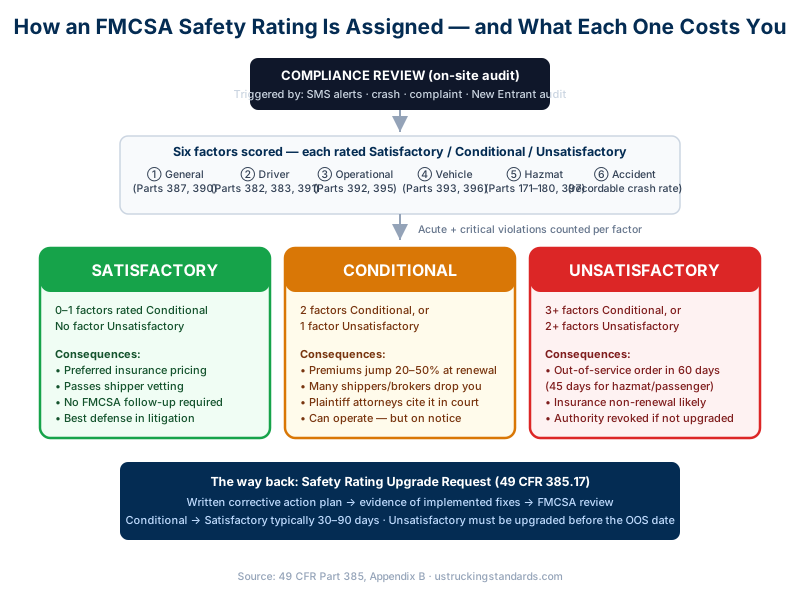
The FMCSA assigns one of three ratings after a compliance review:
- Satisfactory — the carrier has adequate safety management controls in place.
- Conditional — the carrier lacks adequate controls in some area, which could result in violations. You can keep operating, but everyone who checks your record sees the flag.
- Unsatisfactory — controls are inadequate to the point of likely violations. Unless upgraded, the carrier is prohibited from operating: 60 days after the notice for general freight, 45 days for hazmat and passenger carriers.
A fourth state — Unrated — is the default for carriers that have never had a compliance review. It is not a clean bill of health; it means the FMCSA has not looked yet. Most carriers in the United States are unrated.
What Triggers a Rating
Ratings come only from a compliance review — an on-site (or, since 2020, increasingly off-site) audit of your records by an FMCSA investigator or state partner. Roadside inspections and SMS scores do not directly assign a rating; they are what gets you selected for the review.
The usual paths to a compliance review:
- SMS alerts — exceeding intervention thresholds in one or more BASICs (Unsafe Driving, HOS Compliance, Vehicle Maintenance, etc.). The scoring mechanics behind those thresholds are explained in CSA scores and the seven BASICs.
- A serious crash — particularly a fatality, which can trigger a focused review within weeks.
- Complaints — from drivers, the public, or competitors via the National Consumer Complaint Database.
- The New Entrant Safety Audit — every new authority gets one within 12 months. It does not produce a formal rating but a failed audit puts you on the same path.
How the Investigator Scores You
Under 49 CFR Part 385, Appendix B, the investigator evaluates six factors, each tied to specific parts of the regulations:
| Factor | What is examined | Regulations |
|---|---|---|
| 1. General | Insurance filings, accident register | Parts 387, 390 |
| 2. Driver | DQ files, CDL status, drug/alcohol program | Parts 382, 383, 391 |
| 3. Operational | Hours of service, ELD records | Parts 392, 395 |
| 4. Vehicle | Maintenance files, inspection records | Parts 393, 396 |
| 5. Hazardous Materials | Placarding, training, shipping papers | Parts 171–180, 397 |
| 6. Accident | Recordable crash rate per million miles | — |
Each factor receives its own Satisfactory / Conditional / Unsatisfactory grade, driven by acute violations (a single instance is enough — for example, no drug and alcohol testing program at all) and critical violations (a pattern, typically 10% or more of records sampled — for example, false logs across multiple drivers). The six factor grades then combine into the overall rating:
- Satisfactory: no factor Unsatisfactory, no more than one factor Conditional.
- Conditional: two factors Conditional, or one Unsatisfactory.
- Unsatisfactory: three or more Conditional, or two or more Unsatisfactory.
The arithmetic matters because it shows how a Conditional rating is usually earned: not by one catastrophic failure, but by two administrative areas each having a pattern problem — sloppy DQ files and unsupported HOS logs, say. Neither alone would change your rating. Together they do.
What a Conditional Rating Actually Costs
Carriers sometimes read “Conditional” as a warning and carry on. The market reads it differently.
Insurance. Underwriters pull your rating at renewal. A Conditional rating typically moves you out of preferred markets into excess and surplus lines, with premium increases of 20–50% being common and non-renewal notices not unusual. Umbrella coverage becomes difficult to place at any price. Our guide to how OOS rates affect fleet insurance premiums covers the mechanics.
Freight. Large shippers and most brokers run automated carrier vetting. A Conditional rating fails the filter at many of them outright; the rest flag you for manual review. Contracts that require carriers to “maintain a Satisfactory rating” — a standard clause — give the shipper the right to terminate.
Litigation. After a crash, plaintiff attorneys request your rating history in discovery. A Conditional rating in place at the time of the accident is presented to the jury as proof the FMCSA had already found your safety controls inadequate. It is one of the most effective exhibits in nuclear verdict cases — the framework is in our overview of US trucking liability and nuclear verdicts.
What an Unsatisfactory Rating Means
The proposed Unsatisfactory rating arrives with a date. If the rating is not upgraded by that date — 60 days, or 45 for hazmat and passenger operations — an out-of-service order takes effect and operating any commercial vehicle in interstate commerce becomes a federal violation with civil penalties per day.
In practice, the insurance non-renewal usually arrives before the OOS date. Most carriers that receive a proposed Unsatisfactory rating and fail to upgrade it do not close because the FMCSA shut them down; they close because they could not stay insured.
Getting the Rating Changed
The upgrade process under 49 CFR 385.17 is a written request to the FMCSA Division Office that covers your state. It must include:
- A corrective action plan — factor by factor, what was deficient and the specific control you have put in place. “We will do better on logs” fails. “We have replaced our ELD provider, retrained all 14 drivers with documented sign-off on [date], and instituted a weekly log audit by the safety manager, samples attached” succeeds.
- Evidence of implementation — training records, new procedures, audit samples, purchase records for equipment.
- A request for a rating review — the FMCSA may verify by document review or by a follow-up on-site visit.
Timing is the constraint. A Conditional-to-Satisfactory upgrade with a strong package typically clears in 30 to 90 days. A proposed Unsatisfactory rating must be upgraded before the OOS date, which means the corrective action plan needs to be substantially complete within weeks of the review — realistic only if the carrier starts fixing problems the day the investigator leaves, not the day the notice arrives.
Carriers can also petition for administrative review under 385.15 if they believe the rating was assigned in error — factual mistakes in the review, violations attributed incorrectly. This is narrower and slower than the upgrade path and rarely the better option unless the investigator’s findings are genuinely wrong.
The Preventive Position
Everything that produces a Conditional rating is visible in your own records months before an investigator sees them. The compliance review examines the same DQ files, logs, and maintenance records covered in our DOT compliance checklist for new motor carriers — a carrier that self-audits against those items quarterly has already run the review the FMCSA will eventually run.
The rating system rewards documentation over intention. A carrier with real safety culture and thin paperwork rates worse than a mediocre carrier with immaculate files. Build the files.