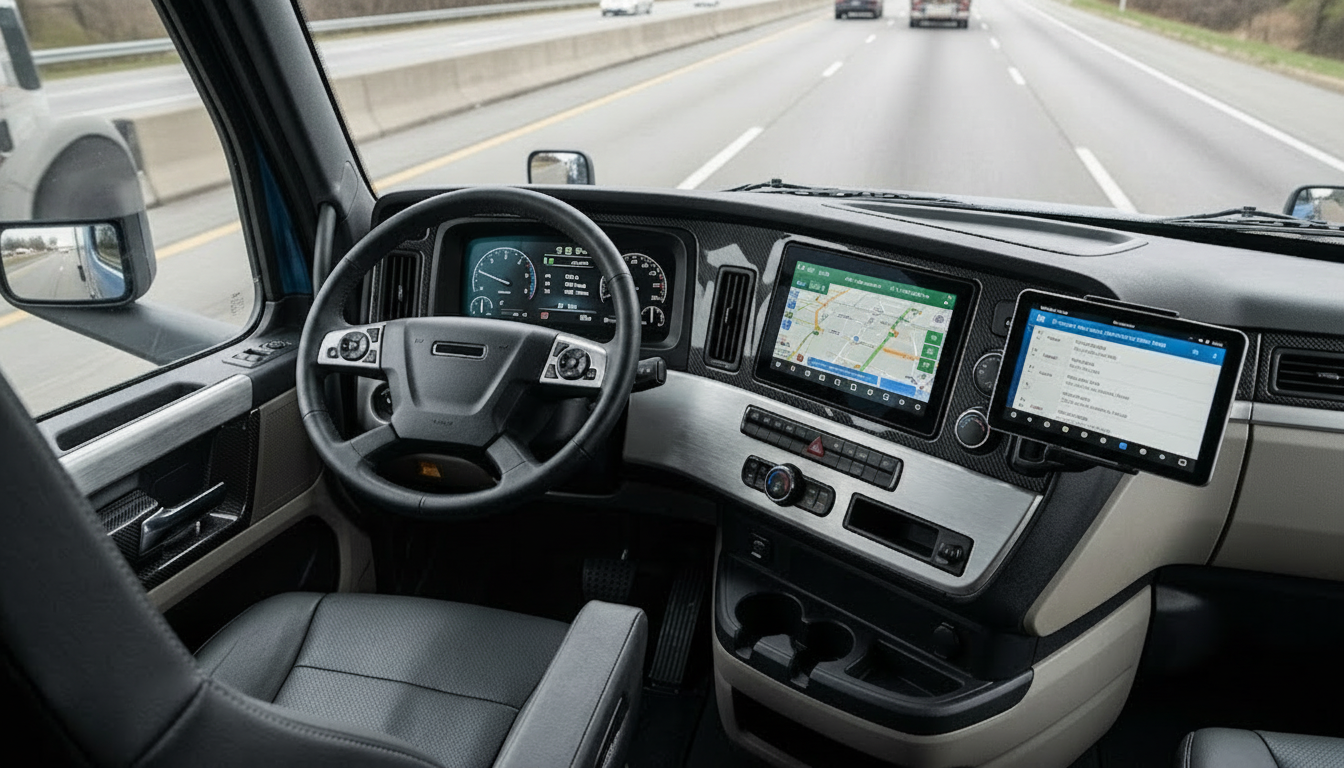
AI Dashcams and Driver Privacy: What Fleets Can Legally Record
· Michael R. Holt
Wiretapping laws, driver consent, and in-cab audio: what motor carriers can legally record with AI dashcams, which states require two-party consent, and how footage cuts both ways in litigation.
AI Dashcams and Driver Privacy: What Fleets Can Legally Record
A fleet manager installs inward-facing AI cameras across forty trucks. The system flags distracted driving, uploads clips automatically, and the insurance discount pays for the hardware in fourteen months. Eighteen months later, a driver files a wiretapping claim over the in-cab audio, and a plaintiff attorney in an unrelated crash case subpoenas every clip the system ever flagged.
Both problems were avoidable. Neither is hypothetical.
Dashcam programs sit at the intersection of three bodies of law that most carriers evaluate separately or not at all: state wiretapping statutes, employment law, and the rules of civil discovery. Here is how each one applies.
The Video Is Rarely the Problem. The Audio Is.
Recording video of a driver at work is broadly lawful. The legal standard is reasonable expectation of privacy, and courts have consistently held that a commercial vehicle cab — a workplace, on public roads, in a federally regulated industry — carries little of it. An inward-facing camera that records video only is on solid ground in every state.
Audio is a different statute entirely. Federal law (18 U.S.C. 2511) and every state wiretapping act govern the interception of oral communications, and they turn on consent.
One-party consent states (the federal standard and the majority of states) require only that one participant in the conversation consent to recording. If the driver consents, the recording is lawful — including conversations the driver has with passengers or over the phone.
All-party consent states require every participant. In these jurisdictions, a driver’s consent does not cover the dispatcher on speakerphone, the lumper at the dock, or a family member on a hands-free call. Recording them without their knowledge can be a criminal offense and, in several states, creates a private right of action with statutory damages per violation.
| All-party consent states | Notes for fleets |
|---|---|
| California | Penal Code 632; statutory damages, criminal exposure |
| Delaware | Broad interpretation by state courts |
| Florida | Applies to any private conversation |
| Illinois | Eavesdropping statute revised after constitutional challenge |
| Maryland | The statute behind most publicized wiretap prosecutions |
| Massachusetts | Among the strictest; no exception for open recording |
| Michigan | Case law split, treat as all-party |
| Montana | Requires notice, not just consent |
| Nevada | Telephone conversations specifically |
| New Hampshire | Criminal penalties |
| Oregon | Different rules for in-person vs. electronic |
| Pennsylvania | Aggressively enforced |
| Washington | Requires announcement of recording |
An interstate carrier crosses these lines routinely. A truck domiciled in Texas — one-party — recording audio while driving through Pennsylvania is subject to Pennsylvania law for conversations that happen there. This is why most large fleets running interstate simply disable in-cab audio recording entirely. The compliance risk outweighs a feature that rarely produces value in a crash investigation.
Driver Consent Is a Document, Not a Conversation
Even where the law permits recording, the enforceable version of consent is written, specific, and signed before the first recording. A defensible dashcam policy states:
- What is recorded — road-facing video, in-cab video, audio (yes or no), telematics data.
- When — continuously, event-triggered, or both. “Event-triggered” systems that buffer continuously should say so; drivers who believe the camera is off between events have not consented to what is actually happening.
- Who can view it — named roles, not “management.”
- How long it is retained — and that retention extends automatically when litigation is anticipated.
- What it will be used for — coaching, discipline, insurance claims, legal defense. If footage can lead to termination, say that.
Collective bargaining changes this analysis. For unionized fleets, installing monitoring technology is generally a mandatory subject of bargaining; unilateral implementation invites an unfair labor practice charge regardless of what the individual drivers signed.
Two states — Illinois and Texas, with others following — regulate biometric data specifically. AI dashcams that perform facial recognition or eye-tracking to detect drowsiness may be capturing biometric identifiers, which in Illinois triggers the Biometric Information Privacy Act: written notice, written release, a published retention schedule, and statutory damages per violation with no requirement to show actual harm. BIPA litigation has produced nine-figure settlements against employers. Before deploying a driver-facing AI system, ask the vendor in writing whether the system creates a biometric template or only analyzes frames transiently.
Footage in Litigation Cuts Both Ways
Carriers adopt dashcams expecting exoneration, and often get it — a road-facing camera showing a passenger vehicle cutting across the truck’s path ends a case that would otherwise settle for six figures. That value is real.
The symmetry is what carriers underestimate. Once a dashcam program exists, everything it recorded is discoverable, and three specific exposures follow:
Spoliation. The moment litigation is reasonably anticipated — typically at the crash, not at the lawsuit — a duty to preserve evidence attaches. A system that auto-deletes on a 30-day cycle and quietly overwrites the relevant clip produces an adverse inference instruction: the jury is told it may assume the destroyed footage was unfavorable. Carriers lose cases on spoliation that they would have won on the facts. Your policy needs a litigation hold procedure that a dispatcher can execute at 2 a.m.
The pattern problem. Plaintiff counsel does not only request the crash clip. They request every flagged event for that driver, and often for the fleet. If your AI system flagged the driver for following distance eleven times in the six months before the crash and your records show no coaching response, the case is no longer about the crash. It is about a carrier that had documented evidence of unsafe driving and did nothing — the core of a negligent retention claim, as covered in our guide to negligent hiring laws and trucking liability.
Selective deployment. Cameras in some trucks and not others, or footage reviewed for some drivers and not others, invites both discrimination claims and the argument that the safety program was cosmetic.
The carriers who benefit from dashcam footage are the ones who close the loop: flag, coach, document the coaching, escalate when the pattern continues. The footage then proves an active safety program rather than a neglected one.
Building a Program That Survives Both Reviews
A dashcam deployment gets examined twice — once by a plaintiff attorney after a crash, once by an FMCSA investigator during a compliance review. The same four elements satisfy both:
- Written policy, signed by every driver, before installation. Re-signed when the system changes.
- Audio off unless you have a specific reason and all-party consent handled. The insurance value of in-cab audio is close to zero; the liability is not.
- A retention schedule you actually follow, with a documented litigation hold override.
- A coaching workflow with records. Every flagged event gets a disposition. “Reviewed, no action needed” is a valid disposition; silence is not.
Fleets that treat dashcams as a hardware purchase get the insurance discount and the discovery exposure. Fleets that treat them as a safety program get the discount, the exposure, and a documented answer for both audiences.
For how telematics participation affects what you pay for coverage, see our analysis of AI dashcams and telematics insurance premiums. For the safety-scoring context an investigator brings to the same records, see FMCSA safety rating explained.
This article is general information on a rapidly changing area of state law, not legal advice. Consent requirements vary by state and are amended frequently — confirm current requirements with counsel licensed in the states where you operate before deploying a recording program.