Lithium Battery Shipping: The Hazmat Class Most Carriers Don't Treat as Hazmat
· Michael R. Holt
UN3480, UN3481, UN3090 and UN3536 explained for motor carriers: which lithium battery shipments require placards, what the small-cell exceptions actually cover, and why thermal runaway changes your fire response.
Lithium Battery Shipping: The Hazmat Class Most Carriers Don’t Treat as Hazmat
Ask a dispatcher whether their fleet hauls hazardous materials and you will get a clear answer about fuel, chemicals, and anything with a diamond placard on the trailer. Ask the same dispatcher whether they haul lithium batteries and the answer is usually “sure, electronics, all the time” — delivered in the tone of someone describing ordinary freight.
Both answers can be true at once, and that is the problem. Lithium batteries are Class 9 hazardous materials under 49 CFR. A large share of lithium shipments move legitimately under exceptions that waive placards and shipping papers, which has produced an industry-wide impression that batteries are not really hazmat. Then a trailer loaded with e-bike packs ignites on an interstate, and the carrier discovers that “excepted” never meant “unregulated.”
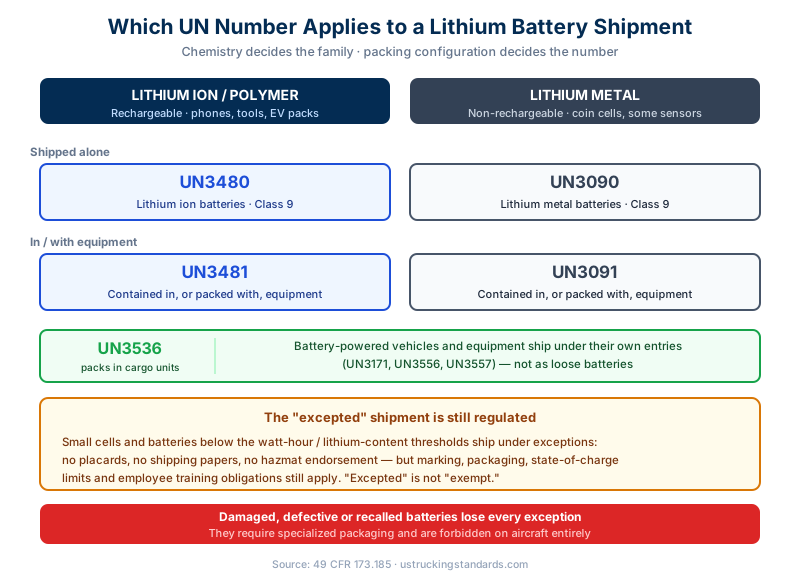
Five Numbers, Two Chemistries, One Decision Tree
The classification depends on two things: what chemistry the battery uses, and how it is packed.
Chemistry splits the field in two. Lithium ion (rechargeable — phones, laptops, power tools, EV packs) falls in the UN3480 family. Lithium metal (non-rechargeable — coin cells, certain medical and industrial sensors) falls in the UN3090 family. Lithium metal is the more energetic of the two and its thresholds are measured differently.
Packing configuration determines the specific number:
| Configuration | Lithium ion | Lithium metal |
|---|---|---|
| Batteries shipped alone | UN3480 | UN3090 |
| Contained in equipment | UN3481 | UN3091 |
| Packed with equipment | UN3481 | UN3091 |
| Packs installed in cargo units / EV modules | UN3536 | — |
“Contained in equipment” means the battery is installed in the device — a laptop in its box. “Packed with equipment” means the battery is loose in the same package as the device it powers. Both take the same UN number, but they have different packaging and quantity rules, and the shipping paper must state which one applies.
Battery-powered vehicles and machinery are a separate matter entirely. An electric car, a forklift, a scooter, or a lawnmower ships under its own entry — UN3171, UN3556, or UN3557 depending on type — not as a battery shipment. Carriers hauling electric vehicles on car haulers are moving regulated freight under a classification most of them have never looked up.
What the Exceptions Actually Waive
Small cells and batteries below defined energy thresholds ship under exceptions in 49 CFR 173.185. This is the provision that produces most of the confusion, because what it waives and what it preserves are both significant.
Waived for qualifying small shipments: placards, shipping papers, emergency response information, and the hazmat endorsement on the driver’s CDL.
Still required, every time:
- Proper packaging that prevents short circuits — terminals protected, batteries secured against movement, no contact with conductive material.
- The lithium battery mark on the outer package, with the UN number and a telephone number for additional information.
- State of charge limits. Lithium ion cells and batteries shipped alone must be at no more than 30% state of charge for transport. This applies by air with particular strictness, and shippers frequently miss it.
- Package limits — quantity per package and per overpack, which vary by cell size.
- Hazmat employee training for anyone who prepares, offers, or handles the shipment. The exception removes the paperwork, not the obligation to know what you are handling. Our guide to DOT hazmat training requirements covers the four training functions, all of which apply here.
The practical summary: excepted means a lighter regulatory load, not an absence of one. A carrier who treats an excepted lithium shipment as general freight is non-compliant even though no placard was required.
The Class 9 Placard Exception Carriers Get Wrong
Here is where lithium diverges from every other hazard class, and it catches people in both directions.
Under 49 CFR 172.504(f)(9), Class 9 placards are not required for domestic transportation within the United States — including the domestic leg of an international shipment. A trailer carrying 5,000 lbs of fully regulated lithium ion batteries does not display a Class 9 placard on US highways.
What is required: bulk packagings of Class 9 material must display the identification number on an orange panel, a placard, or a white square-on-point configuration. And for shipments moving internationally or by air, the Class 9 lithium battery placard applies under IATA and IMDG rules even though it does not domestically.
The absence of a placard does not make the shipment unregulated. Everything else still applies when the consignment exceeds the exception thresholds: shipping papers with the proper shipping name and UN number within the driver’s reach, emergency response information, a 24-hour emergency contact number, and hazmat training on file for everyone who handles it. The packing group question does not arise — Class 9 lithium entries are not assigned packing groups — but every other element of hazmat compliance does.
The practical consequence for drivers: a trailer can be carrying thousands of pounds of lithium batteries with nothing on the outside to announce it. That is legal, and it is also why the documentation in the cab matters more here than in classes where the placard does the communicating. For how placarding thresholds work across the other hazard classes, see our guide to hazmat placard requirements.
The free DOT Placard Calculator handles this distinction: select Class 9 and switch between domestic and international scope to see how the requirement changes.
Damaged and Defective Batteries Lose Everything
A battery that is damaged, defective, recalled, or showing signs of swelling, heating, or leakage falls out of every exception immediately. These shipments require specialized packaging designed to contain a thermal event, specific marking, and they are forbidden on aircraft without exception.
This matters operationally because damaged batteries arrive in the freight network constantly — returns, recalls, warranty replacements, and end-of-life collection. A reverse logistics load of returned power tools is not the same shipment as the outbound load of new ones, and a carrier that handles both on the same terms has a compliance gap in one direction.
Thermal Runaway Changes the Fire Plan
The reason regulators treat lithium differently from other Class 9 materials is the failure mode.
A lithium cell that fails internally enters thermal runaway: an exothermic reaction that heats adjacent cells, which fail in turn, cascading through the pack. The fire produces its own oxygen, which is why smothering does not work, and it can reignite hours after it appears extinguished. It also releases hydrogen fluoride and other toxic gases.
Three operational consequences for drivers and carriers:
- A driver’s fire extinguisher will not put out a lithium pack fire. It may suppress surrounding material and buy time to disconnect the tractor from the trailer, which is often the only useful action available. The priority is distance, not suppression.
- Responding fire services need to know what is in the trailer. This is the practical argument for carrying accurate documentation even on excepted shipments — a responder treating a lithium fire as a conventional cargo fire makes decisions that endanger them.
- Scene release is not the end. A trailer involved in a lithium incident can reignite in a yard or a repair facility days later. The incident reporting obligations in our guide to hazmat spill response apply here, and the post-incident handling needs to account for a load that is not stable just because the flames are out.
The Insurance Gap Worth Checking
Motor truck cargo and physical damage policies were not written with thermal runaway in mind, and some contain exclusions or sub-limits for fire originating in the cargo itself. A trailer destroyed by a battery fire, carrying freight destroyed by the same fire, can produce two claims that both get examined closely.
Before taking regular lithium freight, confirm in writing with your broker how your policies respond to a cargo-origin fire, and whether hauling Class 9 lithium at volume changes your rating. The cost drivers behind commercial truck insurance include commodity risk, and this is a commodity whose risk profile insurers have been revising.
What to Actually Do
For carriers who move electronics, tools, e-mobility products, or EV components — which is most general freight carriers at this point:
- Identify the exposure. Ask shippers directly whether consignments contain lithium batteries and in what configuration. “Electronics” on a BOL is not a classification.
- Train the people who touch it. Dock staff and dispatchers deciding whether a shipment is excepted are performing a hazmat function.
- Verify marking at pickup. The lithium battery mark on the outer package is the fastest check that the shipper classified the load at all.
- Treat reverse logistics separately. Returns and recalls are a different compliance question from outbound.
- Brief drivers on the fire response. Disconnect and distance, not suppression; tell responders what is in the trailer.
The regulatory trend is toward tightening — state-of-charge limits, packaging standards, and reporting requirements have all become stricter as incident data accumulates. Carriers who establish the classification habit now will not have to retrofit it later.
This article is general information on a regulatory area that is actively evolving, not legal advice. Verify current requirements in 49 CFR 173.185 and with PHMSA before establishing shipping procedures.