
How Much Does Commercial Truck Insurance Cost in 2026?
· Michael R. Holt
Real cost ranges for commercial truck insurance in 2026: primary liability, cargo, physical damage and umbrella premiums by operation type, plus the factors that raise or lower your quote.
How Much Does Commercial Truck Insurance Cost in 2026?
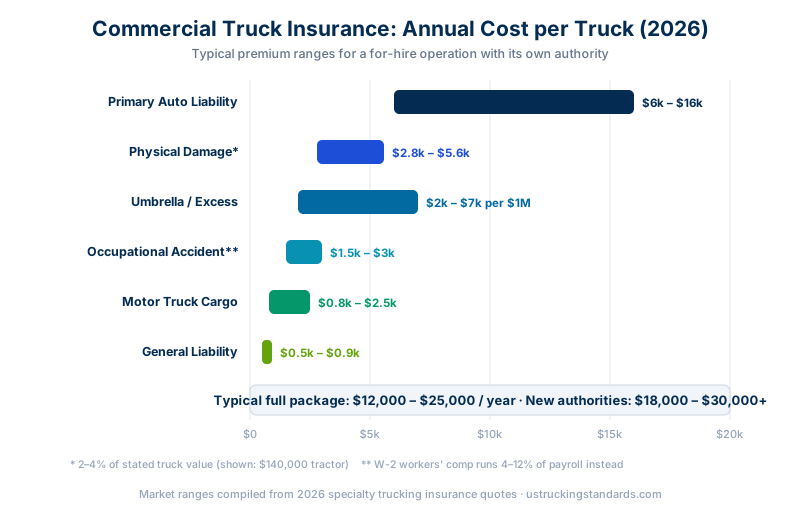
The short answer for a single for-hire truck with its own authority: $12,000 to $25,000 per year for a full coverage package, with new authorities and hazmat operations paying well above that range. The long answer is that no two quotes look alike, because underwriters price your specific operation — and understanding what they price is how you lower the number.
Here is what the market actually looks like in 2026, coverage by coverage.
The Core Package: What Each Coverage Runs
Primary Auto Liability — $6,000 to $16,000/year per truck. The legally required foundation (minimum $750,000 for general freight; brokers demand $1M). This is where most of your premium lives, and where the spread is widest: a 10-year veteran with a clean CAB report pays a third of what a new authority pays for identical limits.
Motor Truck Cargo — $800 to $2,500/year. Covers the freight itself, typically at $100,000 limits. Commodity matters: hauling electronics or copper costs more than hauling paper. Reefer breakdown coverage adds to the bill.
Physical Damage — 2% to 4% of the truck’s stated value per year. A $140,000 tractor runs $2,800 to $5,600 annually. Older equipment can skip it — if you can absorb the loss of the truck.
General Liability — $500 to $900/year. Cheap and often bundled; covers non-driving exposures like loading dock injuries.
Umbrella/Excess — $2,000 to $7,000/year per million. Increasingly demanded by shippers, increasingly expensive to place in the nuclear-verdict era. Excess underwriters read your FMCSA safety data before quoting anything.
Workers’ Compensation — 4% to 12% of driver payroll. Mandatory for W-2 drivers in nearly every state; occupational accident policies for 1099 owner-operators run $1,500 to $3,000/year but cover far less.
What a Real Operation Pays
| Operation type | Typical annual total (per truck) |
|---|---|
| New authority, first year, dry van | $18,000 – $30,000 |
| Established owner-operator (3+ yrs), dry van | $9,000 – $16,000 |
| Small fleet (5-15 trucks), mixed freight | $10,000 – $18,000 |
| Reefer operation | $12,000 – $20,000 |
| Flatbed / oversized | $13,000 – $22,000 |
| Hazmat / tanker | $18,000 – $40,000+ |
The first-year premium cliff is real: insurers price new authorities as unknowns, and the discount for surviving year one to year three is typically 25-40%.
The Factors You Control
Underwriters build your quote from data you generate every day:
- FMCSA safety scores and OOS rates — the single biggest controllable factor. A fleet above the national OOS average pays surplus-lines rates; how that works is covered in our guide to how OOS rates impact fleet insurance premiums.
- Radius of operation — local (under 100 miles) prices below regional; long-haul interstate prices highest.
- Driver MVRs and age — one driver under 25 or with a recent moving violation moves the whole quote.
- Telematics participation — carriers offering dashcam/ELD data-sharing programs see discounts of 5-15%.
- Deductibles and stated values — raising physical damage deductibles from $1,000 to $2,500 trims premium meaningfully.
The Factors You Don’t
Market-wide forces have pushed commercial auto premiums up for over a decade: nuclear verdicts (jury awards over $10M against carriers), social inflation, rising equipment repair costs, and reinsurance pricing. This is why a spotless operation still sees single-digit percentage increases at renewal in 2026 — flat is the new down.
How to Actually Lower Your Quote
- Fix your safety data first — quotes follow your FMCSA record with a lag; violations age off the SMS in 24 months, weighted less as they age.
- Shop with a trucking-specialist broker — general commercial agents cannot access the specialty markets that price trucking accurately.
- Present a safety packet — written maintenance program, training records, dashcam policy. Underwriters price uncertainty; documentation removes it.
- Structure limits deliberately — a $1M primary with a $4M umbrella usually beats a $5M primary on price; the mechanics are in our breakdown of primary liability vs umbrella policies.
- Never let coverage lapse — a lapse in authority insurance re-prices you as a new venture.
For how driver classification affects the workers’ comp piece — and what happens when a 1099 driver is ruled an employee — see workers’ compensation for commercial truck drivers.