Trucking Insurance Requirements by State: Minimum Limits Every Carrier Must Carry
· Michael R. Holt
Federal FMCSA liability minimums for interstate carriers, how intrastate rules differ by state, and the state-by-state reference table of trucking insurance requirements for 2026.
Trucking Insurance Requirements by State: Minimum Limits Every Carrier Must Carry
Two sets of rules govern how much liability insurance a motor carrier must carry, and confusing them is one of the most common mistakes new authorities make. Interstate carriers answer to federal minimums under 49 CFR Part 387. Intrastate carriers — those operating entirely within one state — answer to that state’s own rules, which range from mirroring the federal floor to demanding far less.
This guide lays out both, with a reference table you can check against your operation.
The Federal Floor (Interstate Carriers)
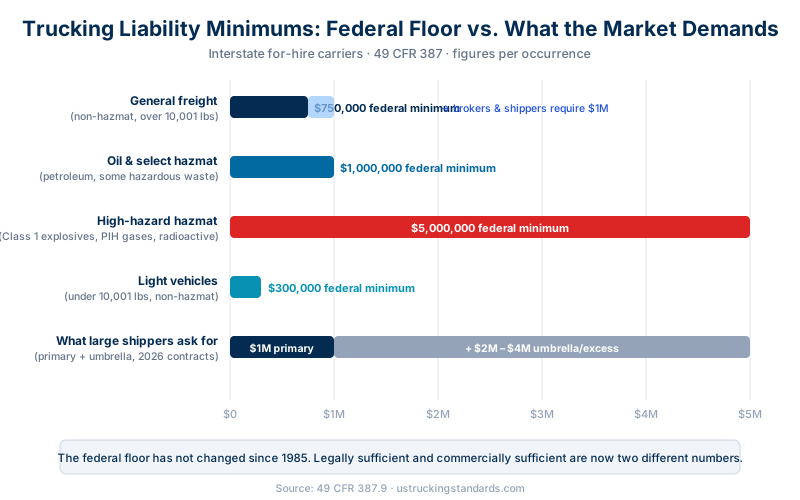
If you cross state lines for hire, the FMCSA sets your minimum public liability coverage — bodily injury, property damage, and environmental restoration — based on what you haul:
| Cargo type | Vehicle weight | Federal minimum |
|---|---|---|
| Non-hazardous freight | 10,001 lbs or more | $750,000 |
| Non-hazardous freight | Under 10,001 lbs | $300,000 |
| Oil; certain hazardous waste and hazmat in cargo tanks | Any | $1,000,000 |
| Class 1 explosives (Div. 1.1–1.3), poison-inhalation gases, radioactive, high-quantity hazmat | Any | $5,000,000 |
Proof takes the form of the MCS-90 endorsement attached to your policy and, for authority activation, a Form BMC-91 or BMC-91X filed by your insurer with the FMCSA. Household goods movers also carry cargo insurance minimums ($5,000 per vehicle / $10,000 per occurrence) that general freight carriers do not.
These numbers have not been updated since 1985. Adjusted for inflation, $750,000 then is roughly $2.2 million today — which is why the legal minimum and what a shipper or broker will actually accept are now different figures.
The Commercial Reality
Federal compliance gets your authority activated. It does not get you loads. Freight brokers and shippers set their own thresholds in carrier agreements, and in 2026 the market standard for general freight is:
- $1,000,000 auto liability (not $750,000)
- $100,000 motor truck cargo
- $1,000,000 general liability, increasingly requested
- $2M–$5M umbrella/excess for large shippers, retail distribution, and hazmat
A carrier legally insured at $750,000 will find most load boards and brokers will not tender freight. Treat $1M as the practical minimum. What that costs is covered in our breakdown of commercial truck insurance costs in 2026.
Intrastate Requirements: Where States Diverge
Carriers operating solely within one state fall under state law, and here the picture fragments. Most states adopt the federal Part 387 figures by reference for vehicles over 10,001 lbs; a significant minority set their own — sometimes much lower — minimums, particularly for smaller vehicles or specific commodity classes.
The table below shows the intrastate general-freight minimum for vehicles over 10,001 lbs GVWR. Verify with your state DOT or Public Utilities Commission before relying on it — states amend these figures, and several apply different tiers by vehicle weight or commodity.
| State | Intrastate minimum (>10,001 lbs, non-hazmat) | Notes |
|---|---|---|
| Alabama | $750,000 | Adopts federal |
| Alaska | $750,000 | Adopts federal |
| Arizona | $750,000 | Adopts federal; $300k for 10,001–26,000 lbs |
| Arkansas | $750,000 | Adopts federal |
| California | $750,000 | Adopts federal; CA MCP permit required |
| Colorado | $750,000 | Adopts federal |
| Connecticut | $750,000 | Adopts federal |
| Delaware | $750,000 | Adopts federal |
| Florida | $300,000 | 26,001–35,000 lbs: $300k; 35,001–44,000: $500k; over 44,000: $750k |
| Georgia | $100,000 / $300,000 / $50,000 | Split limits for intrastate; federal for interstate |
| Hawaii | $750,000 | Adopts federal |
| Idaho | $750,000 | Adopts federal |
| Illinois | $750,000 | Adopts federal |
| Indiana | $750,000 | Adopts federal |
| Iowa | $750,000 | Adopts federal |
| Kansas | $750,000 | Adopts federal |
| Kentucky | $750,000 | Adopts federal |
| Louisiana | $750,000 | Adopts federal |
| Maine | $750,000 | Adopts federal |
| Maryland | $750,000 | Adopts federal |
| Massachusetts | $750,000 | Adopts federal |
| Michigan | $750,000 | Adopts federal; no-fault PIP applies |
| Minnesota | $750,000 | Adopts federal |
| Mississippi | $750,000 | Adopts federal |
| Missouri | $750,000 | Adopts federal |
| Montana | $750,000 | Adopts federal |
| Nebraska | $750,000 | Adopts federal |
| Nevada | $750,000 | Adopts federal |
| New Hampshire | $750,000 | Adopts federal |
| New Jersey | $750,000 | Adopts federal |
| New Mexico | $750,000 | Adopts federal |
| New York | $750,000 | Adopts federal; NYC-area operators face additional local rules |
| North Carolina | $750,000 | Adopts federal |
| North Dakota | $750,000 | Adopts federal |
| Ohio | $750,000 | Adopts federal |
| Oklahoma | $750,000 | Adopts federal |
| Oregon | $750,000 | Adopts federal |
| Pennsylvania | $750,000 | Adopts federal |
| Rhode Island | $750,000 | Adopts federal |
| South Carolina | $750,000 | Adopts federal |
| South Dakota | $750,000 | Adopts federal |
| Tennessee | $750,000 | Adopts federal |
| Texas | $500,000 | Over 26,000 lbs: $500k; household goods and hazmat higher |
| Utah | $750,000 | Adopts federal |
| Vermont | $750,000 | Adopts federal |
| Virginia | $750,000 | Adopts federal |
| Washington | $750,000 | Adopts federal |
| West Virginia | $750,000 | Adopts federal |
| Wisconsin | $750,000 | Adopts federal |
| Wyoming | $750,000 | Adopts federal |
The outliers matter. A Texas intrastate carrier can operate legally at $500,000; a Georgia intrastate carrier at split limits that would be inadequate for a single serious injury claim. In both states, carriers who later add interstate authority discover their existing policy falls short of the federal filing — a gap that delays authority activation by weeks.
The Coverages States Do Not Mandate — But Contracts Do
Liability is the only coverage federal and state law universally require. Everything else is contractual:
- Motor truck cargo — required by virtually every broker agreement, not by law (except household goods).
- Physical damage — required by your lender if the truck is financed.
- Workers’ compensation — required by state law for W-2 employees in nearly every state, with Texas as the notable opt-out exception. Occupational accident coverage for 1099 owner-operators is contractual, not statutory. The classification question — and its consequences when a court disagrees with you — is covered in workers’ compensation for commercial truck drivers.
- Umbrella/excess — required by shipper contracts above a certain freight value or commodity risk.
A carrier that meets every legal minimum and nothing more is legally operating and commercially stranded. Build your insurance program to the contract standard, not the statutory one; how to layer those coverages efficiently is covered in primary liability vs umbrella policies.
State figures reflect general-freight minimums as commonly published for 2026. Requirements change; confirm with the relevant state agency before making coverage decisions.