
Strategic Cargo Theft: How Criminals Impersonate Carriers — and What to Do If It's Your MC Number
· Michael R. Holt
How strategic cargo theft and fraudulent double brokering work, why motor truck cargo insurance usually does not cover them, and the exact steps to take when your carrier identity has been stolen.
Strategic Cargo Theft: How Criminals Impersonate Carriers — and What to Do If It’s Your MC Number
A carrier in Ohio gets a call from a broker demanding to know where a load of consumer electronics went. The carrier has never heard of the broker, never bid on the load, and had all four of its trucks within a hundred miles of its yard on the day in question. It does not matter. The rate confirmation, the bill of lading, and the certificate of insurance all carry the carrier’s MC number, its DOT number, and a reasonable copy of its logo.
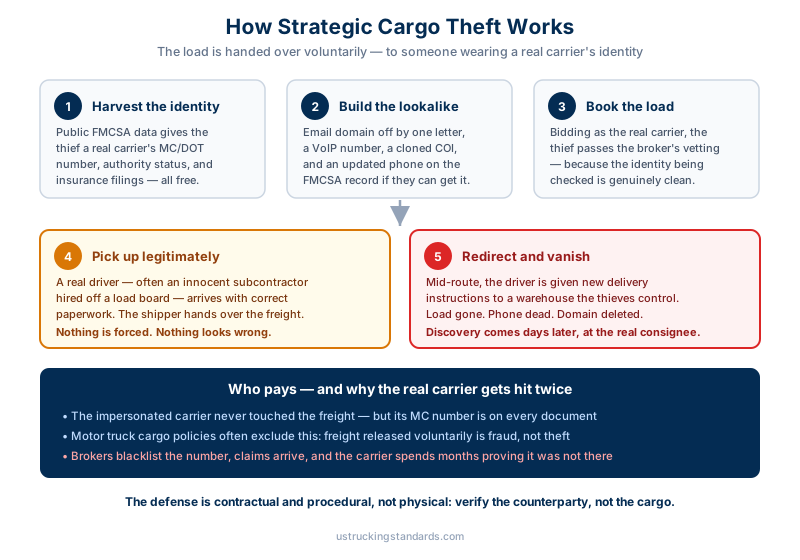
This is strategic cargo theft, and it has become one of the defining operational risks in American freight. Unlike the warehouse break-ins and trailer thefts that cargo security has always dealt with, nothing here is forced. The freight is handed over voluntarily, by people following normal procedures, to someone wearing a legitimate carrier’s identity.
Why the Public Record Is the Attack Surface
The FMCSA’s transparency is a safety feature and, inverted, the starting point of the fraud. Anyone can pull a carrier’s MC and DOT numbers, authority status, insurance filings, fleet size, cargo classifications, and contact details — for free, in seconds, for every carrier in the country.
That is everything needed to impersonate a company that passes vetting. The thief is not building a fake carrier from nothing; they are borrowing a real one with a clean record, active authority, and current insurance on file. When a broker runs their standard check, the check comes back clean because the identity being checked is genuinely clean.
The operation around that identity is thin and disposable: an email domain one character off the real one (-logistics instead of logistics, or .co instead of .com), a VoIP phone number, a cloned certificate of insurance edited in a PDF editor, and sometimes — the most damaging version — an actual change to the contact information on the carrier’s FMCSA record, obtained by compromising the carrier’s USDOT portal credentials.
How the Load Disappears
The mechanics are consistent across cases:
Booking. The impersonator bids on a load board or responds to a broker’s posting, presenting as the real carrier. Rates are competitive but not suspiciously low — being the cheapest bidder draws scrutiny. Communications are professional. Paperwork is complete.
Pickup. This is the part that defeats most security thinking. The driver who arrives at the shipper is frequently a real, innocent driver — an owner-operator hired off a load board by the impersonator acting as a broker, with no idea the chain above them is fraudulent. They have the correct pickup number, the right paperwork, and a legitimate truck. The shipper has no reason to refuse the load, and in most cases no practical ability to verify that the person in the truck works for the entity named on the BOL.
Redirection. Somewhere mid-route, the driver receives updated delivery instructions: a different warehouse, a cross-dock, a lumper arrangement. This is routine enough in freight that it raises no alarm. The driver delivers the load to the new address, gets a signature, and gets paid. The freight is transferred to another trailer within hours.
Discovery. The theft surfaces when the real consignee reports a missing delivery — typically one to three days later, by which point the phone number is disconnected, the domain is deleted, and the warehouse was a short-term rental under a shell company.
The Insurance Problem Nobody Expects
Carriers and shippers assume motor truck cargo insurance covers this. It frequently does not, and the reason is a distinction buried in policy language that matters enormously here.
Cargo policies are written to cover theft — property taken without the owner’s consent. What happens in strategic cargo theft is, in insurance terms, closer to fraud: the freight was released voluntarily by someone with authority to release it, induced by misrepresentation. Many policies contain explicit exclusions for loss resulting from the voluntary parting with property, acceptance of fraudulent documents, or infidelity of parties to whom the goods were entrusted.
Three consequences follow:
- The shipper’s claim may fail against its own cargo policy, which pushes it toward the parties it can identify.
- The broker’s contingent cargo coverage is often similarly limited, and broker-carrier agreements typically make the carrier liable for the full value of the freight.
- The impersonated carrier, which never touched the load, receives the claim — because its MC number is on every document in the chain.
If you haul high-value freight, the question to put to your broker in writing is specific: does your policy respond to loss by fraudulent pickup or impersonation, and if not, is a fictitious pickup endorsement available? These endorsements exist, they are not standard, and most carriers have never asked. Our overview of motor truck cargo insurance covers the baseline coverage this sits on top of.
If Your Identity Has Been Stolen
For the carrier being impersonated, the damage is reputational and administrative before it is financial. Brokers blacklist the MC number. Claims arrive. Load board accounts get suspended. Proving a negative — that your trucks were not there — takes months and the burden is effectively on you.
Act in this order:
1. Document your position immediately. Pull ELD records, GPS history, fuel receipts, and driver logs for the dates in question. Evidence that your equipment was demonstrably elsewhere is the core of your defense, and the records have retention limits — preserve them now, not when the lawsuit arrives.
2. Check and lock your FMCSA record. Log into the FMCSA portal and verify every contact field: address, phone, email, and the officials listed on the record. If anything has been altered, change it back and document the change with screenshots. Enable multi-factor authentication. A compromised FMCSA account is the most serious version of this problem because it lets the thief redirect inquiries to themselves.
3. File the reports that create a paper trail. The FMCSA’s National Consumer Complaint Database for the impersonation, the FBI’s IC3 for the fraud itself, and a report with local law enforcement. None of these is likely to recover the freight. All of them give you documentation that you reported the fraud on a date certain — which is what you will need when a broker alleges you were complicit.
4. Notify your insurer and your broker relationships proactively. A carrier that reports “our identity is being used fraudulently, here is the documentation” before the claims arrive is treated very differently from one that responds to accusations.
5. Alert the load boards and vetting services. DAT, Truckstop, Carrier411, Highway, and RMIS all have fraud reporting channels. Getting a flag on your profile noting an active impersonation protects you with brokers who check.
6. Consider counsel. Where significant freight value is involved, the claims that follow are civil litigation, and early legal involvement shortens the process considerably.
Defending Against It Prospectively
The defenses are procedural, and they apply differently depending on which side of the transaction you are on.
If you are a carrier: monitor your own MC number periodically — search it on load boards and see whether anyone else is posting as you. Set up alerts on your company name. Use multi-factor authentication on the FMCSA portal and your load board accounts. Keep your FMCSA contact details current, because a thief who updates a stale record is harder to contradict than one who contradicts a fresh one.
If you are brokering or co-brokering freight: verify the counterparty, not the credentials. The credentials will check out — that is the entire design of the scheme. What does not survive verification is the contact path: call the phone number listed on the FMCSA record, not the one on the email signature. Check the email domain’s registration date — a domain created three weeks ago for a carrier operating since 2014 is the single most reliable signal. Be suspicious of carriers whose contact details on the FMCSA record changed recently.
If you are shipping high-value freight: require photo ID matching the driver’s name to the paperwork at pickup, photograph the tractor and trailer plates, and treat mid-route delivery address changes as an exception requiring verification through a known contact — not through the email chain already in progress.
The Structural Point
Cargo security historically meant locks, seals, yard lighting, and team drivers on high-value lanes. None of that engages with a theft where the freight is handed over at the dock by a shipper following its own procedures correctly.
The exposure has moved from the physical layer to the contractual and verification layer, and the insurance market has not fully caught up — which is why carriers hauling high-value freight should read their cargo policy’s exclusions before they need to, and why the carriers getting hit hardest are the ones who assumed a clean compliance record was protection. It is not. A clean record is precisely what makes an identity worth stealing.
This article is general information, not legal or insurance advice. Policy language varies materially between insurers — review your specific coverage with your broker.